WEAK SUPERVISION · TEMPORAL LEARNING

Rows Are Not Evidence Units: Evidence-Unit Invariance in Weak Temporal Localization

Should a model change when a table repeats the same evidence?

Amir Reza Peimani2026Submitted / under review

Ordinary joins and repeated exports can change preprocessing, training weights, and predictions without adding evidence. A semantic quotient makes the learning pipeline invariant to redundant row materialization.

Weak annotations often arrive as tables. Their storage layout can silently determine how much influence an annotation receives, even when its scientific meaning stays the same.

Approach

Compile rows into evidence units before fitting preprocessing and constructing risk. The provenance contract preserves distinctions between sources, annotation types, temporal support, and independent emissions.

Main result

0.23absolute segment-F1 change from redundant rows

Across seven temporal datasets, the ordinary learner changed under a prespecified five-copy intervention while the quotient response was zero. In the confirmatory PPG-DaLiA evaluation, ordinary segment F1 fell by 0.228. Clean performance met the retention criterion on six datasets; HAPT was the exception.
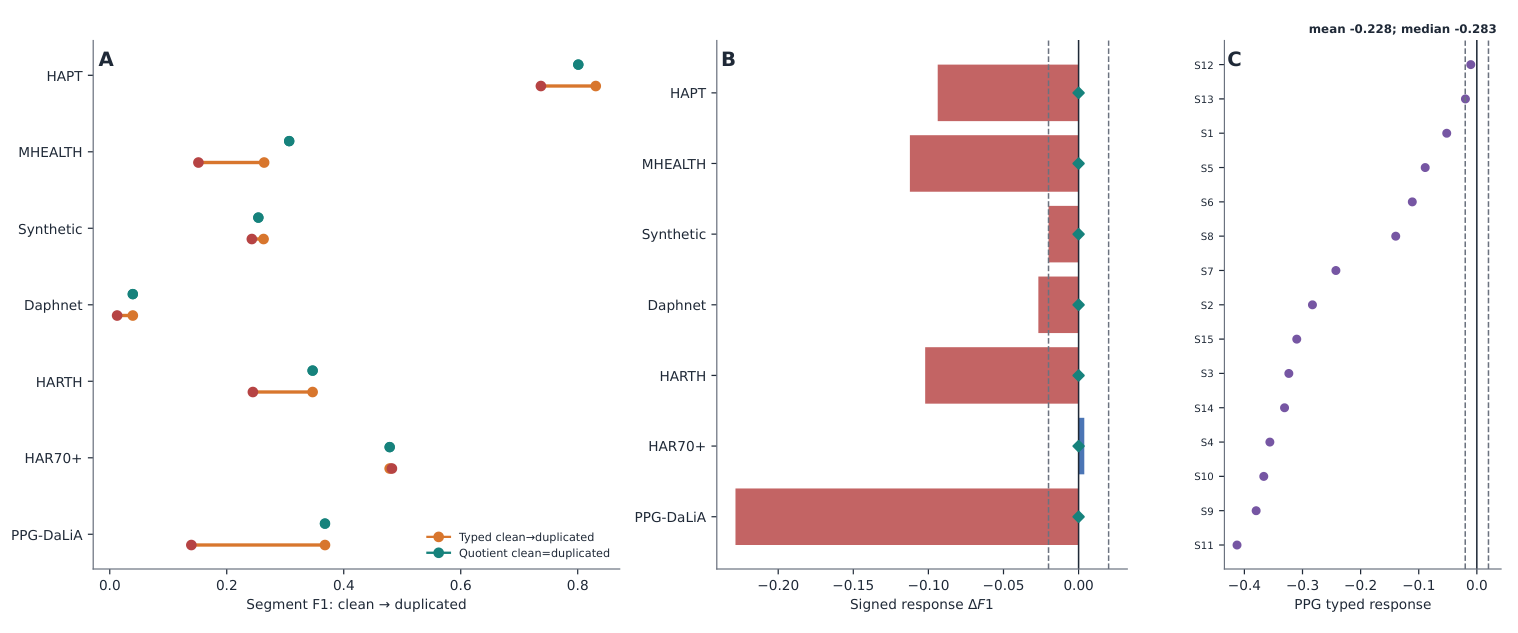
Response to redundant serialization. Original Figure 3: clean and duplicated segment F1, signed changes, and responses for all 15 held-out PPG-DaLiA subjects. The quotient results coincide.
Response to redundant serialization. Original Figure 3: clean and duplicated segment F1, signed changes, and responses for all 15 held-out PPG-DaLiA subjects. The quotient results coincide. Open full resolution ↗
How redundant rows change temporal predictions
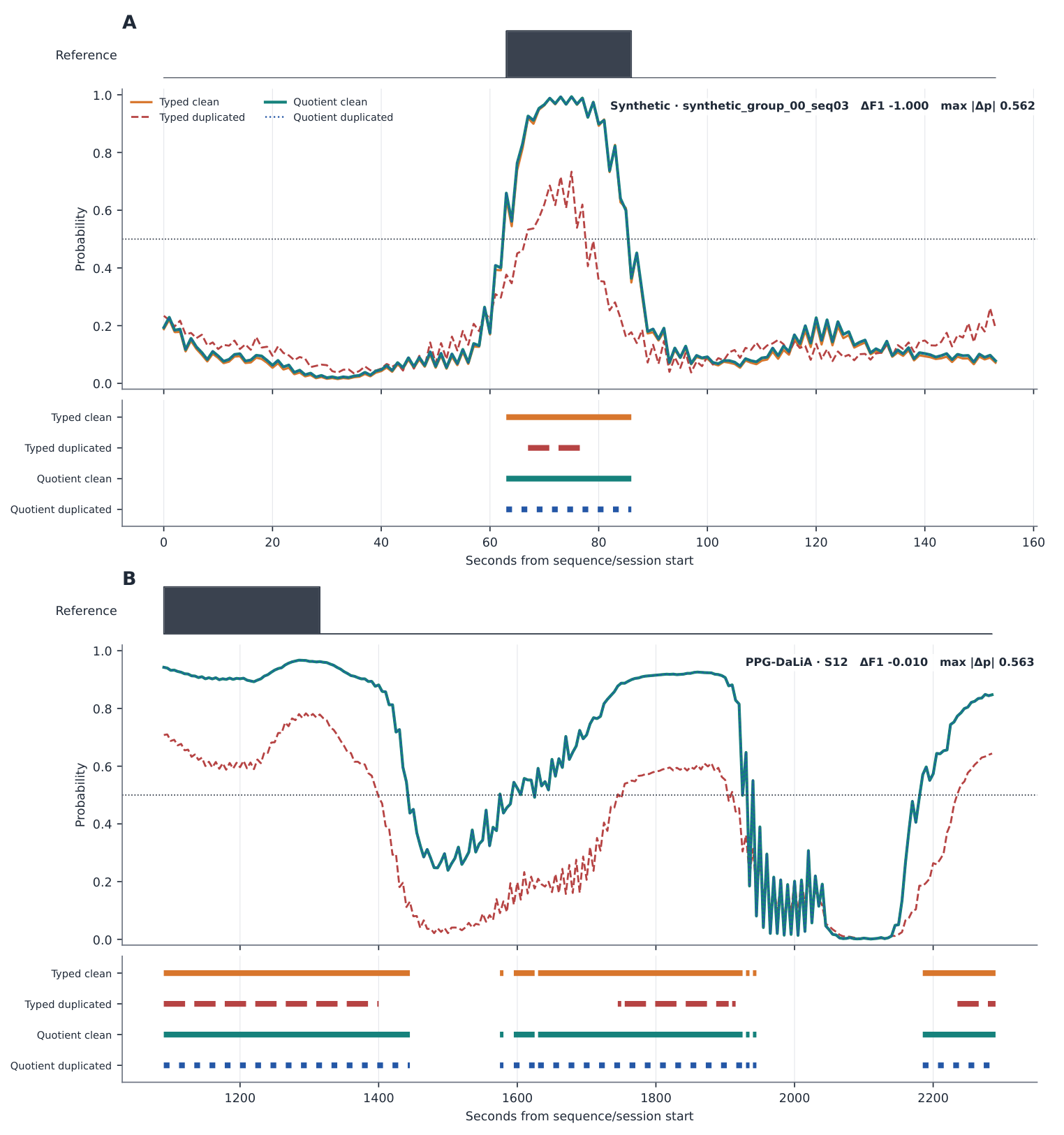
Figure 5. Reference intervals, model probabilities, and decoded intervals for held-out Synthetic and PPG-DaLiA sequences. Ordinary predictions change after row duplication; quotient outputs coincide. The manuscript selects the largest Synthetic F1 degradation and the median-ranked PPG-DaLiA subject by probability response.
Figure 5. Reference intervals, model probabilities, and decoded intervals for held-out Synthetic and PPG-DaLiA sequences. Ordinary predictions change after row duplication; quotient outputs coincide. The manuscript selects the largest Synthetic F1 degradation and the median-ranked PPG-DaLiA subject by probability response. Open full resolution ↗